
Awareness doesn’t stop after you walk through the door.
In fact, the most effective safety practices in schools aren’t one-time actions. They are small habits repeated consistently throughout the day.
The good news? These habits don’t require extra time, special training, or disruption to your routine.
They only require intention.
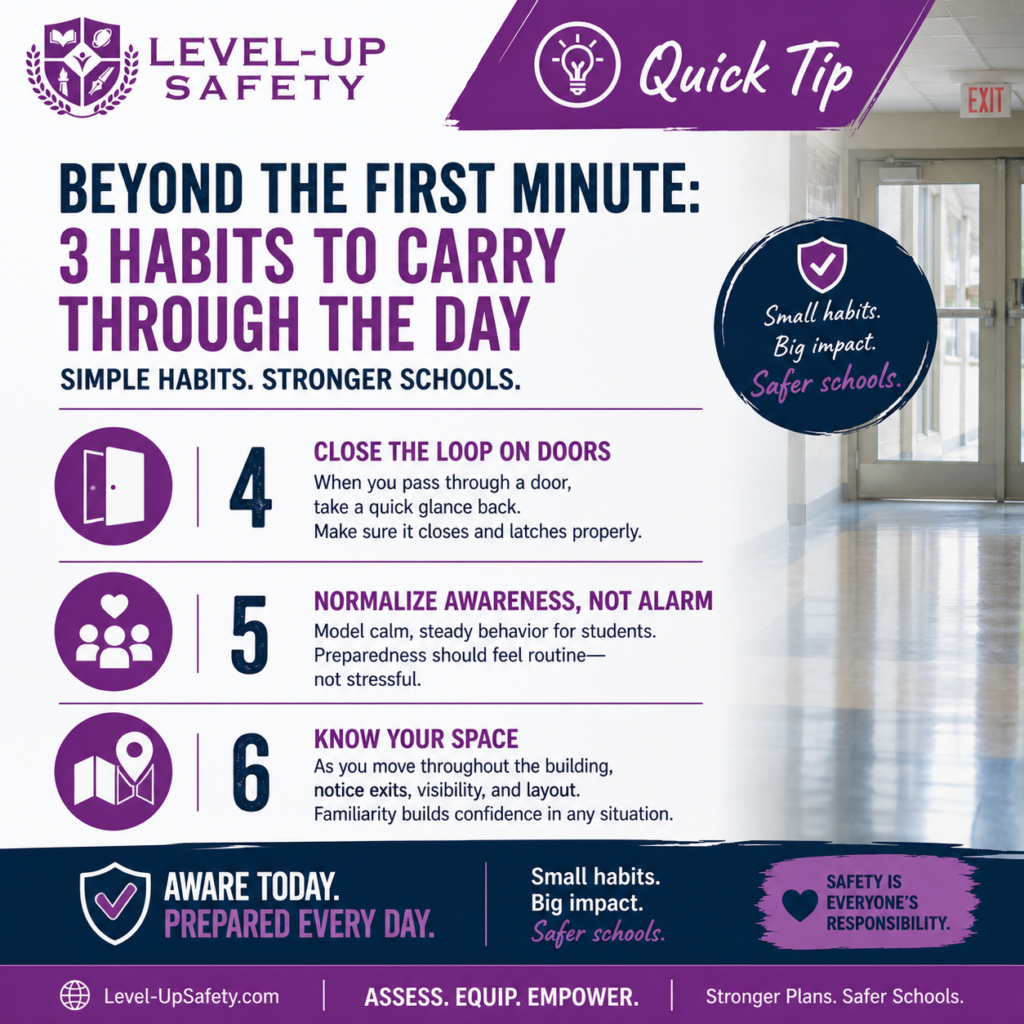
1. Close the Loop on Doors
Doors are one of the most important, and most overlooked, parts of school safety.
Throughout the day, classroom and hallway doors are opened for convenience, collaboration, or movement. But over time, small habits can unintentionally create gaps.
A simple shift:
-
- When you pass through a door, take a quick glance back
-
- Ask: Did it fully close? Did it latch properly?
-
- If something doesn’t seem right, say something early
Not to say that everything is always your responsibility but noticing the small things before they become bigger issues certainly gives you the edge to say something and get it handled (or at least, pass along the message).
Unfortunately in many real-world incidents, it’s not the absence of a plan, it’s a door that didn’t close.
2. Normalize Awareness, Not Alarm
Students take their cues from the adults around them.
When awareness feels calm and routine, students respond with confidence instead of fear.
Simple ways to model this:
-
- Use matter-of-fact language during drills and transitions (move over there, hold onto this, etc.)
-
- Avoid urgency in tone unless it’s truly needed (don’t yell, scream or snap)
-
- Reinforce that safety practices are part of everyday school life (just like evacuation drills or lining up)
You don’t need to explain everything.
You just need to create an environment where preparedness feels normal.
Over time, this builds a culture where students understand what to do, without any anxiety attached to it.
3. Mentally Map Your Movement Throughout the Day
Think about how often you move through different parts of the building:
-
- Classrooms
-
- Hallways
-
- Cafeteria
-
- Gymnasium
-
- Offices
Each space has a slightly different layout, and therefore different options.
As you move throughout your day, start to casually note:
-
- Alternate exits in shared spaces
-
- Areas that provide visibility (easy to see) vs. concealment (easy to hide)
-
- How your environment changes depending on time of day
Reminder: This is not about memorizing floor plans. Just have an awareness about what options are available to you throughout your day and as you move through your environment.
It’s about building a familiarity with your surroundings so that, if needed, you’re not figuring things out for the first time under stress.
Why These Habits Matter
In school safety, we often focus on large plans, policies, and procedures, and those absolutely matter.
But real-world readiness is built on something much simpler:
What people notice and do in the moments no one is watching.
These everyday habits don’t create fear.
They create confidence.
They reduce hesitation and build up your muscle memory.
And they strengthen the effectiveness of every plan already in place.
A Simple Takeaway
If the first 60 seconds are about awareness…
Then the rest of the day is about consistency.
Close the loop.
Stay calm.
Know your space.
Because safer schools aren’t built on big moments alone, they’re built on the small ones that happen every day.
Free Download: 6 School Safety Tips – Quick Guide
Free Resource: 6 School Safety Tips - Quick Guide