
Whether you’re an educator, administrator, support staff member, or visitor there’s one moment we often overlook when it comes to safety:
The moment you walk through the door.
In those first 60 seconds, you have an opportunity to set yourself up for awareness, confidence, and readiness, without adding stress or fear.
These aren’t complicated steps. They’re really simple shifts in attention that can make a meaningful difference.
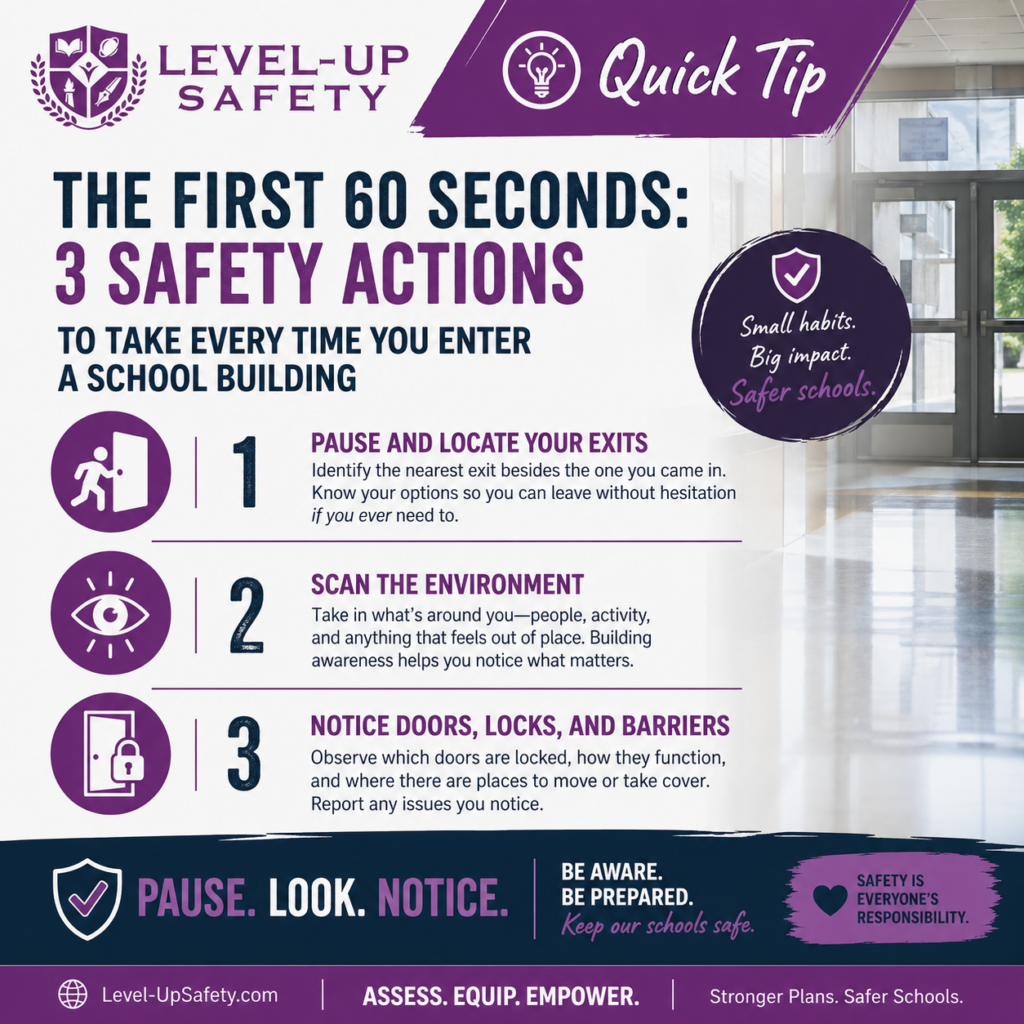
Here are the top 3 steps.
1. Pause and Locate Your Exits
As routine as it may feel to walk into a school, every building, and even every room, can be slightly different. Even if you’ve walked into the same building a hundred thousand times before, take a moment to notice and remind yourself of a few things.
Take a quick moment to ask yourself:
-
- Where did I just enter from?
-
- What’s the nearest exit besides the one I came in?
-
- If I had to leave quickly, which direction would I go?
You’re not expecting something to happen, you are removing hesitation IF something ever does.
In high-stress situations, people don’t rise to the occasion, they fall back on what they’ve already noticed and processed.
That quick mental note now becomes clarity later. And the more you keep this information at the top of your mind, the more automatic it becomes.
Remind yourself where the exists are for every space you visit throughout your day. And if you want the extra credit assignment, use this method when you’re out at the mall, at restaurants, movie theaters and anywhere else you travel.
Just one run through in your mind can be the difference between a brisk exit or a panic stricken mob scene.
2. Scan the Environment, Without Overthinking It
This is not about being on edge. It’s about being present.
As you walk in, take in your surroundings naturally:
-
- Who is around you? (students, staff, visitors)
-
- What feels typical for this time of day?
-
- Is anything noticeably out of place?
Most of the time, everything will feel exactly as it should, and that’s a good thing.
But building the habit of awareness means that if something does feel off one day, you’re far more likely to recognize it early.
Think of it as building your internal “baseline” of normal.
3. Notice Doors, Locks, and Barriers
Without interrupting your routine, start paying attention to the physical environment:
-
- Which doors are locked or unlocked?
-
- Do classroom doors close and latch properly?
-
- Are there spaces to move out of sight if needed?
You don’t need to test anything or draw attention, just notice.
This awareness helps in two ways:
-
- It gives you a better understanding of your environment in real time.
- It helps identify small issues early (before they become bigger concerns).
Over time, this habit also strengthens communication because you’ll know exactly what to report if something isn’t functioning the way it should.
Why This Matters
Safety doesn’t come from memorizing a checklist once a year.
It comes from small, consistent habits that build awareness over time.
These three actions take less than a minute but they shift you from passive to prepared in a calm, grounded way.
No fear. No disruption. Just readiness.
Today’s Takeaway:
Next time you walk into a school building, try this:
Pause. Look. Notice.
That’s it.
Because safety isn’t just about what you do in an emergency, it’s everything that you’ve already taken in before one ever begins.
Free Resource: 6 School Safety Tips - Quick Guide